무엇을 찾고 계신가요?

A hand cream tube sits in a bathroom cabinet, a desk drawer, or a handbag for weeks. Consumers touch the package every day, squeeze it repeatedly, and judge the brand by how cleanly the product dispenses. Packaging therefore shapes first impressions, protects the formula from air and contamination, and controls how much cream leaves the tube. A well-chosen hand cream packaging tube also lifts shelf appeal, keeps the formula stable, and holds unit costs in line. This guide compares tube types, weighs material options, and shares practical selection tips. Buyers can then brief a hand cream tubes manufacturer with clear priorities instead of guesswork.
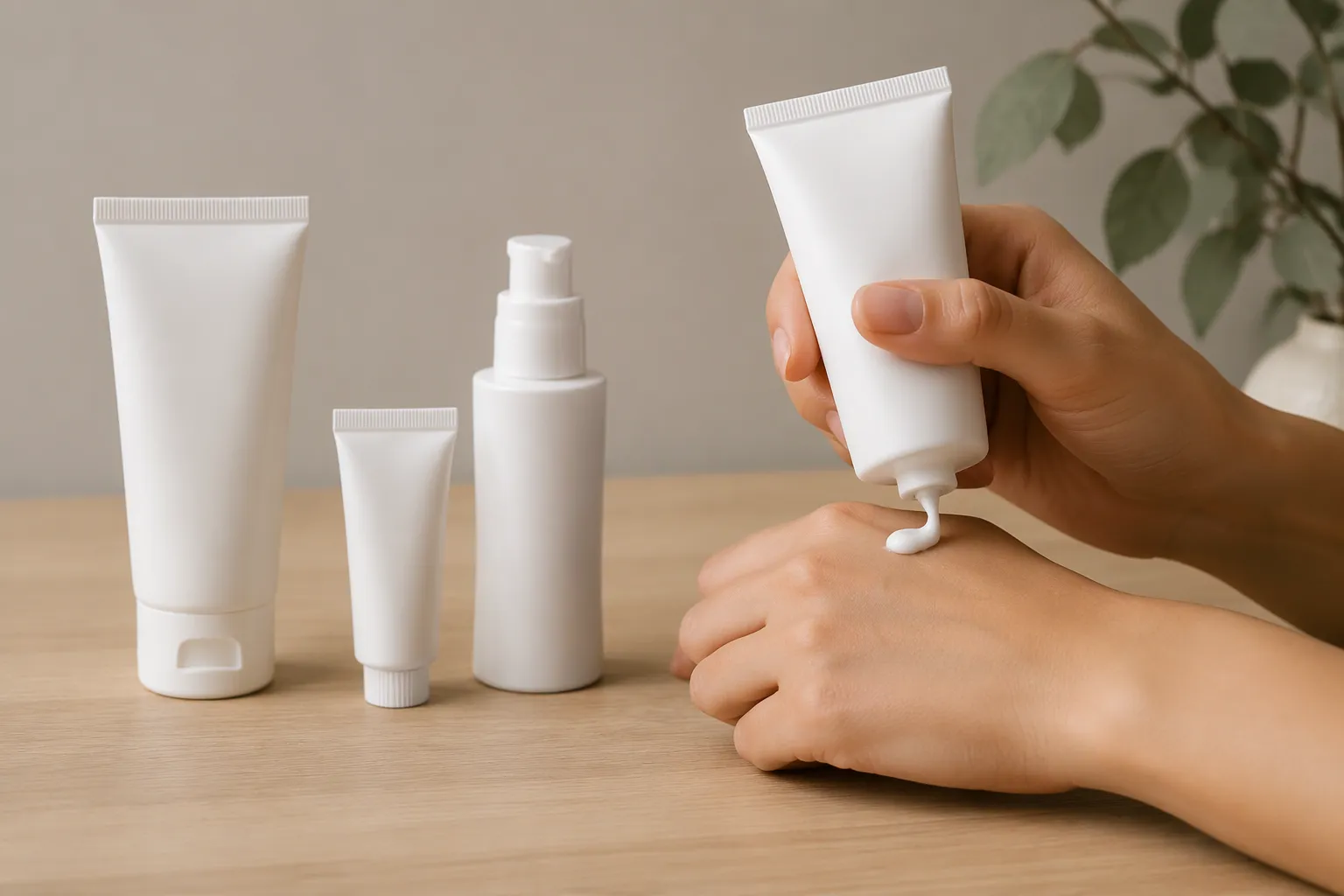
Choose squeeze tubes for affordable and fast production of stable hand creams.
Select airless tubes to protect sensitive ingredients and deliver precise doses.
Match tube material to your formula: plastic for value, aluminum for maximum protection, and eco options for sustainability.
Pick the right size and cap style to fit how customers use the hand cream.
Plan your budget and order quantity early to avoid surprises and ensure a smooth launch.
Hand cream is a repeat-use product, and consumers often carry it between home, office, and travel. Tubes answer that habit well. Xinfly Packaging describes compact portable designs as a core strength of cosmetic tube packaging, and the format suits hand cream, lotion, and personal care products alike. Sizes reinforce the point. Dolytube lists common capacities of 30ml, 50ml, 75ml, and 100ml, with travel-friendly options at 30ml, 50ml, and 100ml. Three Bamboo reports tube diameters from 16mm to 60mm and volumes from 15ml to 150ml. A 20ml refillable squeeze tube with a flip cap even meets hand-luggage rules, according to a Noon product listing.
Everyday handling matters just as much. Cosmetic Plastic Tube notes that a sealed end with a cap or flip-top lid gives easy access while keeping the product protected. The squeezable body lets users control the amount dispensed and apply the cream without mess. MJ Packaging adds that flip-top caps, screw caps, and nozzle tips each add convenience, and a travel-sized hand cream may benefit most from a compact flip-top design.
A good tube shields the formula and meters the dose. Lansen Pack reports that an airtight seal minimizes exposure to air, bacteria, and contaminants, which preserves active ingredients such as vitamin C and retinol. Tube walls may be single-layer, double-layer, or a five-layer structure with EVOH barrier technology; the five-layer version delivers the highest protection and freshness retention. Laminated constructions such as ABL and PBL also offer strong barrier properties, and aluminum resists light, air, and moisture especially well.
Dispensing control completes the picture. Boyu Packaging explains that the user controls the dose by squeezing, and the tube opening is not a calibrated dosing mechanism. Outlet size and squeeze force therefore set the flow. Some cream may remain around the shoulder or seal, and flexible walls help but do not guarantee complete emptying. Buyers who want tighter control can specify an airless pump, which prevents air from entering the tube, or a needle-nose tip for targeted application. A hand cream tubes manufacturer can match these features to the formula's thickness and the brand's positioning.
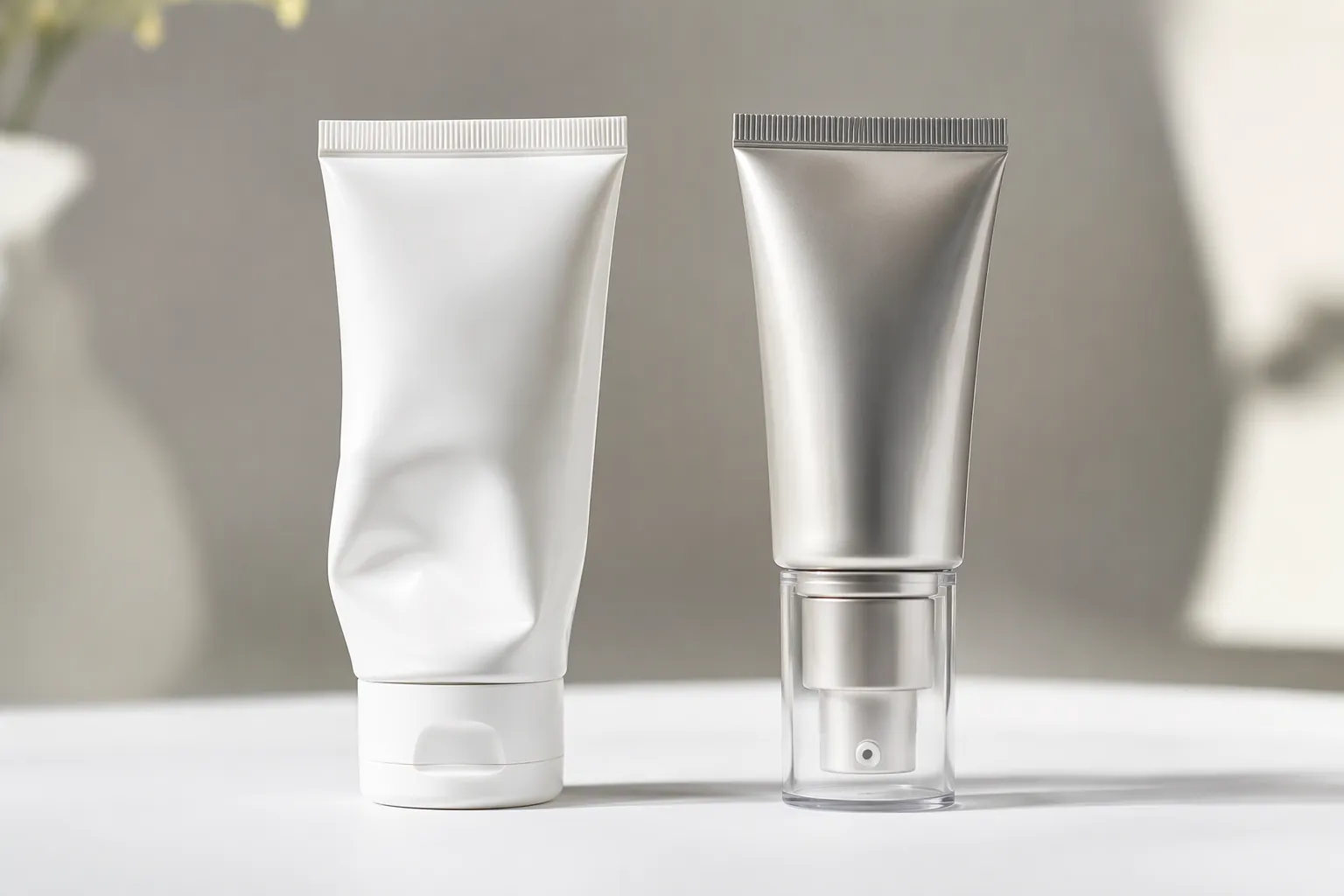
Tube formats divide into two broad families. Squeeze tubes dominate volume sales, and airless or specialized formats serve formulas that need tighter protection or more precise dosing. Each family fits a different product brief.
A squeeze tube uses a flexible body that collapses as the user presses it. The Packaging Company lists hand cream tubes among the core uses of this format, alongside body care and facial cleanser packaging. Round PE tubes remain the most common and competitive style in the industry, according to Cosmetic Tube. A typical 25 mm round tube carries 15 ml to 60 ml, runs 55 mm to 150 mm in sealed length, and accepts mono-layer, double-layer, or five-layer construction. The body uses LDPE or HDPE, and the cap uses PP.
Variants multiply the options. The Packaging Company separates large cosmetic tubes for full-size skincare from small squeeze tubes for samples and travel kits, applicator tubes for targeted application, aluminum tubes for premium lines, and eco-friendly tubes for sustainability goals. Closure choice shapes the user experience. Function Packaging notes that flip-top caps support one-handed dispensing with a hygienic seal, screw-on closures suit creams and premium products, and induction-seal caps add tamper evidence for e-commerce transit. A flat-profile black PE tube from Lisson Packaging shows how far the format stretches: a square cap lets the tube stand upright, and a precision orifice controls flow for both lightweight lotions and thicker creams.
An airless pump tube combines the portability of a squeeze tube with the metered dosing of a pump. Impacked Packaging explains the mechanism: a sealed system replaces the dip tube, and an internal piston or collapsible inner chamber advances product toward the pump. Pressing the actuator opens the outlet valve and releases a pre-metered dose. On release, the inlet valve draws in the next charge. The formula stays isolated from outside air throughout, which reduces oxidation and contamination and maximizes evacuation.
Lisson Packaging compares the two formats directly. Airless tubes offer superior protection for active ingredients such as retinol, vitamin C, peptides, and acids, deliver highly precise dosing, and extend shelf life. Squeeze tubes cost less, produce faster, and suit stable formulas with preservatives. Impacked Packaging lists hand creams among common airless applications, together with vitamin C creams, retinol creams, and SPF moisturizers. Viscosity decides the match. Thin, watery formulas may dispense inconsistently from an airless system, and very thick creams can demand higher actuation force. Testing with the actual formula early is the safe path.
Specialized squeeze variants cover narrower jobs. Lisson Packaging catalogs nozzle tubes, applicator tubes, dual-chamber packaging, and tubes with droppers, massage brushes, or metal slanted tips. Function Packaging cites common outlet references of roughly 1.5 mm, 3 mm, and 5 mm, while noting that these are not universal rules. A hand cream packaging tube with a disc-top cap suits thicker creams, and a flip-top cap remains the default for lotions. Buyers should confirm the final orifice against real formula viscosity. A hand cream tubes manufacturer can supply samples across several formats, so the brand compares dispensing behavior before committing to bulk.
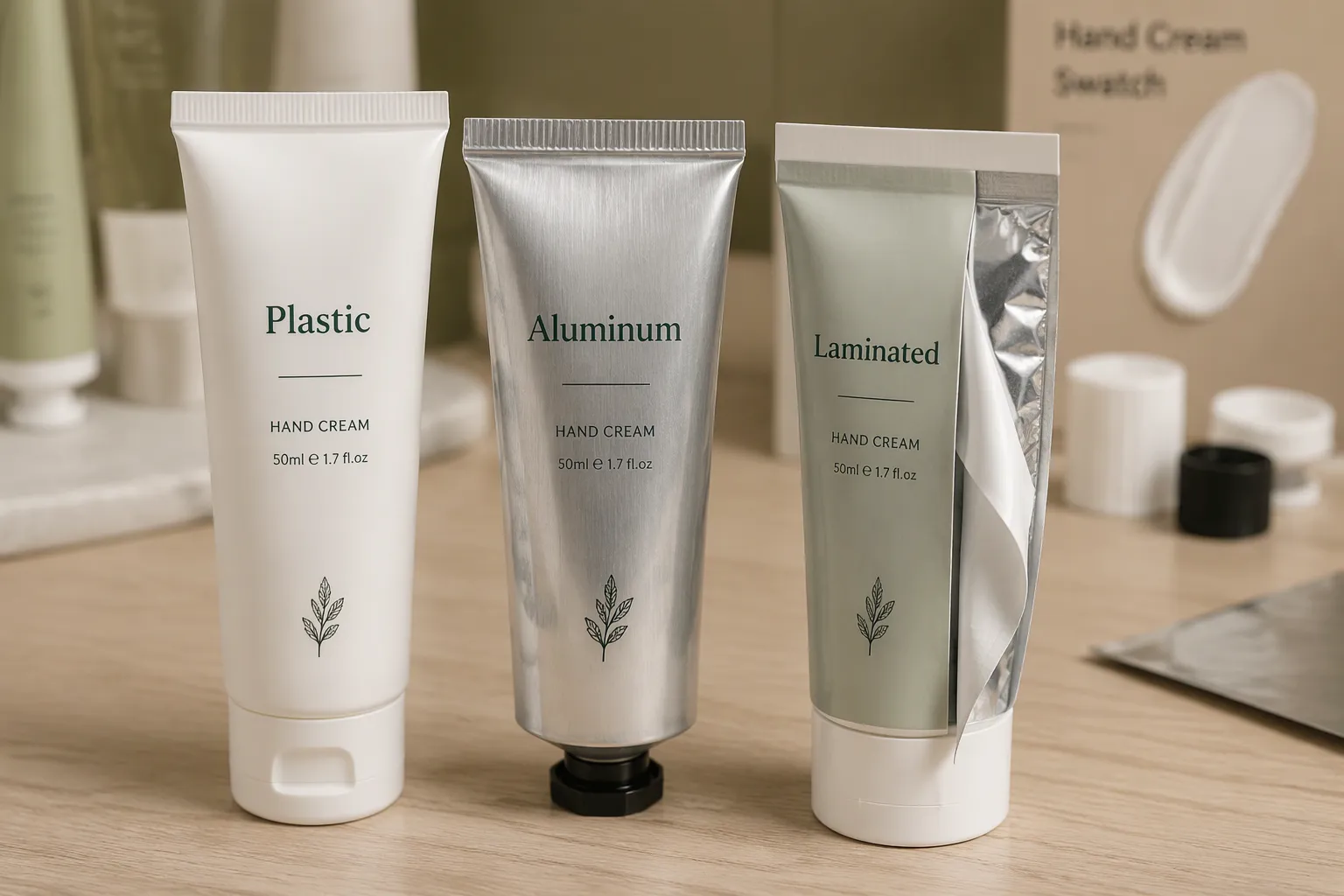
MJ Packaging groups cosmetic tubes into four material families: plastic, aluminum, laminated, and biodegradable or eco-friendly constructions. Plastic leads the market. Lisson Packaging notes that polyethylene tubes remain the most widely used format in beauty and personal care, valued for flexibility, durability, and compatibility with high-speed filling lines. Standard PE resists moisture well and handles most formulas, yet it offers limited oxygen and light protection. Stable hand creams fit this family comfortably, and PE delivers the lowest unit cost at scale.
Aluminum serves brands that put formula protection first. Lisson Packaging explains that a pure aluminum tube carries an internal protective lacquer and collapses as product leaves, so air cannot re-enter. This construction blocks oxygen, light, and moisture exceptionally well and slows oxidation during repeated use. Aluminum also suits premium positioning, and Function Packaging reports that it recycles indefinitely without quality loss. The trade-off is cost: Function Packaging lists aluminum at roughly 30–50% more than plastic, with unit prices from $0.15 to $0.90 against $0.05 to $0.35 for plastic.
Laminated tubes split into two branches, and the choice between them matters for a hand cream packaging tube aimed at sensitive formulas.
|
Feature |
ABL |
PBL |
|---|---|---|
|
Barrier layer |
Aluminum foil |
Plastic, often EVOH |
|
Protection |
Almost absolute |
Excellent, slightly less |
|
Squeeze behavior |
Dead-fold, stays creased |
Bounce-back, recovers shape |
|
Recyclability |
Not fully recyclable |
Fully recyclable |
|
Best fit |
Sensitive creams needing high barrier |
Cost- and recycling-focused briefs |
Xinfly Packaging describes ABL as the high-barrier option for sensitive skincare, while PBL suits mid-range products where cost and recycling weigh heavily. Famer Packaging adds that PBL recovers more readily after repeated squeezing, which daily-use hand cream benefits from.
Eco-focused buyers now have several routes. Cosmetic Tube catalogs PCR tubes made from post-consumer recycled plastic, including 100% PCR recyclable versions and 50% PCR options. Sugarcane-based bio-PE and wheat straw plastic tubes offer renewable feedstocks, and paper-based tubes round out the list. Imore Packaging sells a paper-plastic hand cream tube combining natural paper with PCR PE, fitted with a PP flip-top cap and leak-proof sealing.
Cost shapes the decision. Function Packaging puts paper-based tubes at $0.20–$0.60 per unit, biodegradable tubes at $0.25–$0.70, and recycled plastics at $0.15–$0.50, all above conventional plastic. Performance holds up: Io Packaging reports that sugarcane tubes match traditional plastic on shelf stability while carrying a carbon-negative footprint and full recyclability. A hand cream tubes manufacturer can confirm which eco material suits a given formula, and Xinfly Packaging cites a natural skincare brand that switched its hand cream to PBL tubes to match its green image and saw sales rise afterward. Each family has a clear home: PE for volume and value, aluminum for maximum protection, ABL for sensitive actives, PBL for balanced barrier and recycling, and paper or PCR for sustainability-led launches.
Size decisions start with fill volume and formula texture. Xinfly Packaging recommends 30mm to 35mm diameters for medium hand cream, which balances squeeze feel and portability. A 50ml tube in a 30mm diameter remains the most common retail size, according to Yurtenpack, while 30ml suits pocket and gift formats. Thick, balm-like creams benefit from wider 35mm to 40mm bodies, which improve squeezing comfort.
|
Fill Volume |
Typical Diameter |
Typical Use |
|---|---|---|
|
20–30 ml |
22–25 mm |
Pocket size, travel kits |
|
50 ml |
30 mm |
Most common retail size |
|
75 ml |
30–35 mm |
Everyday desk or car size |
|
100 ml |
35 mm |
Home and value sizes |
Cap style follows the use case. Yurtenpack notes that flip-top caps open with one hand and cannot be lost, which suits daily 50–100ml tubes. Screw caps seal most securely for pocket and travel sizes. Acrylic-style or metallic overcaps lift premium ranges.
Decoration shapes shelf appeal. Auber Packaging lists silk screen printing for bold solid colors and functional text, hot stamping for metallic logos, and soft-touch coating for a velvety, grippy finish that resists fingerprints. Famer Packaging advises brands to discuss foil effects with the printer early, because printed gold and stamped foil look quite different.
A structured checklist keeps a hand cream packaging tube project on schedule. DEZHOU confirms a general minimum order quantity of 5,000 pieces for custom cosmetic tube projects, though special materials or decoration can raise it. Auber Packaging reports typical MOQs of 10,000–20,000 pieces for printed PE and laminated tubes, and 20,000–30,000 for aluminum. Xinfly Packaging puts typical lead time at about 35–50 days from proof approval to factory delivery.
Confirm fill volume, diameter, material, and orifice against the formula.
Match the tail-seal structure to the contract filler's equipment.
Provide editable vector artwork and approve a print proof.
Request physical samples and run a compatibility and filling trial.
Approve a golden sample before mass production begins.
Confirm MOQ per SKU, not just total volume.
A hand cream tubes manufacturer can guide each step, from sample review to bulk production.
Decoration turns a plain hand cream packaging tube into a brand asset. The Tube Packaging lists offset printing for photographic color accuracy, screen printing for durable spot colors, hot stamping for metallic accents, and shrink sleeves for full-surface graphics. Io Packaging adds embossing and debossing for a premium tactile feel, window cutouts that show the product, and color variations from pastels to metallics. Lisson supports custom printing, finishing, and physical samples, so brands can test these effects before committing to a run.
Compliance checks protect the launch. The Tube Packaging names FDA compliance for US materials, EU Cosmetics Regulation for European markets, and Proposition 65 warnings for California channels. Transmo Packaging advises virgin, food-contact grade plastics and certificates covering material safety and origin. Buyers should also confirm labeling rules for the target market.
Verify material safety documentation and certificates of analysis.
Confirm FDA or EU labeling requirements for the destination market.
Run burst, drop, torque, and compatibility tests before approval.
Keep a golden sample and inspection record for each batch.
Unit cost responds to material, structure, decoration, and volume. Xinfly Packaging breaks a 75ml tube price into PE resin, extrusion, shoulder forming, printing, cap production, and packing with quality control. Decoration drives cost upward: one- or two-color screen printing sits at the low end, while hot stamping and soft-touch coating add charges. Volume matters most. Xinfly Packaging quotes roughly $0.18–$0.25 per piece at 5,000 units and $0.09–$0.14 at 100,000 or more.
Purchasing guidance starts with identical specifications. Xinfly Packaging recommends sending the same request for quotation to shortlisted suppliers, covering formula, fill volume, material, diameter, closure, decoration, quantity, and destination. Xinfly Packaging also reports lead times of 4 to 12 weeks. A reliable hand cream tubes manufacturer confirms manufacturing depth, closure engineering, and quality standards before signing, and third-party inspection adds assurance before shipment.
Three decisions shape a successful hand cream packaging tube: the format, the material, and the finishing details. Squeeze, airless, and specialized formats each serve a different formula and price point. Plastic, aluminum, laminated, and eco options trade protection against cost and sustainability. Size, cap style, and decoration then complete the brief.
A tube that matches the formula, budget, and brand goals protects the cream and earns repeat purchases. Readers can work through the checklist above, request samples, and confirm minimum order quantities before committing. A packaging partner such as Lisson can turn that comparison into a confident order. Clear specifications today set up a smoother launch tomorrow.
The formula and budget decide the format. Squeeze tubes cost less, produce faster, and fit stable creams with preservatives. Airless tubes protect actives such as retinol and vitamin C and deliver precise doses. A hand cream tubes manufacturer can supply samples of both, so the brand compares real dispensing behavior.
Aluminum and ABL offer the strongest barrier against air, light, and moisture. Aluminum blocks all three and collapses as product leaves. ABL uses a foil layer and holds a dead-fold. PBL and standard PE fit stable formulas where cost and recycling matter more. Testing with the actual formula confirms the match.
A 50ml tube with a 30mm diameter is the most common retail size for hand cream packaging tubes. Pocket and travel formats typically run 20–30ml at 22–25mm. Home and value sizes reach 100ml at about 35mm. Thick, balm-like creams squeeze more comfortably from wider 35–40mm bodies.
Custom projects generally start at 5,000 pieces, though special materials or decoration can raise the minimum. Printed PE and laminated tubes often require 10,000–20,000 pieces. Plan roughly 35–50 days from proof approval to factory delivery, and up to 4–12 weeks overall.
Yes. PCR plastic, sugarcane-based bio-PE, and paper-plastic tubes all suit hand cream, and sugarcane tubes match conventional plastic on shelf stability. Expect higher unit costs than standard plastic. A hand cream tubes manufacturer can confirm which eco material suits a given formula before sampling begins.