무엇을 찾고 계신가요?

Hand cream packaging tubes do two jobs at once. They shield a delicate formula from air, light, and contamination, and they carry your brand identity onto the shelf.
You face a practical question. How do tubes perform on product protection, application fit, regulatory compliance, and cost? Each answer shapes the final choice for your hand creams.
This article examines both sides of the decision. It looks at how tubes deliver reliable protection for skincare creams, and how packaging design turns cosmetic packaging into a branding asset. You will see how thoughtful product packaging balances the two priorities, and how the right packaging supports every tube you place in a customer's hands.
Tubes protect hand cream from air, light, and contamination, keeping the formula fresh and effective.
Choose the right tube material and closure to control dispensing and prevent waste or contamination.
Follow cosmetic regulations to ensure the packaging is safe and compliant with labeling laws.
Balance cost and features: plastic tubes are affordable, while aluminum tubes offer premium protection.
Use the tube's surface for branding with colors, printing, and finishes to attract customers and build trust.
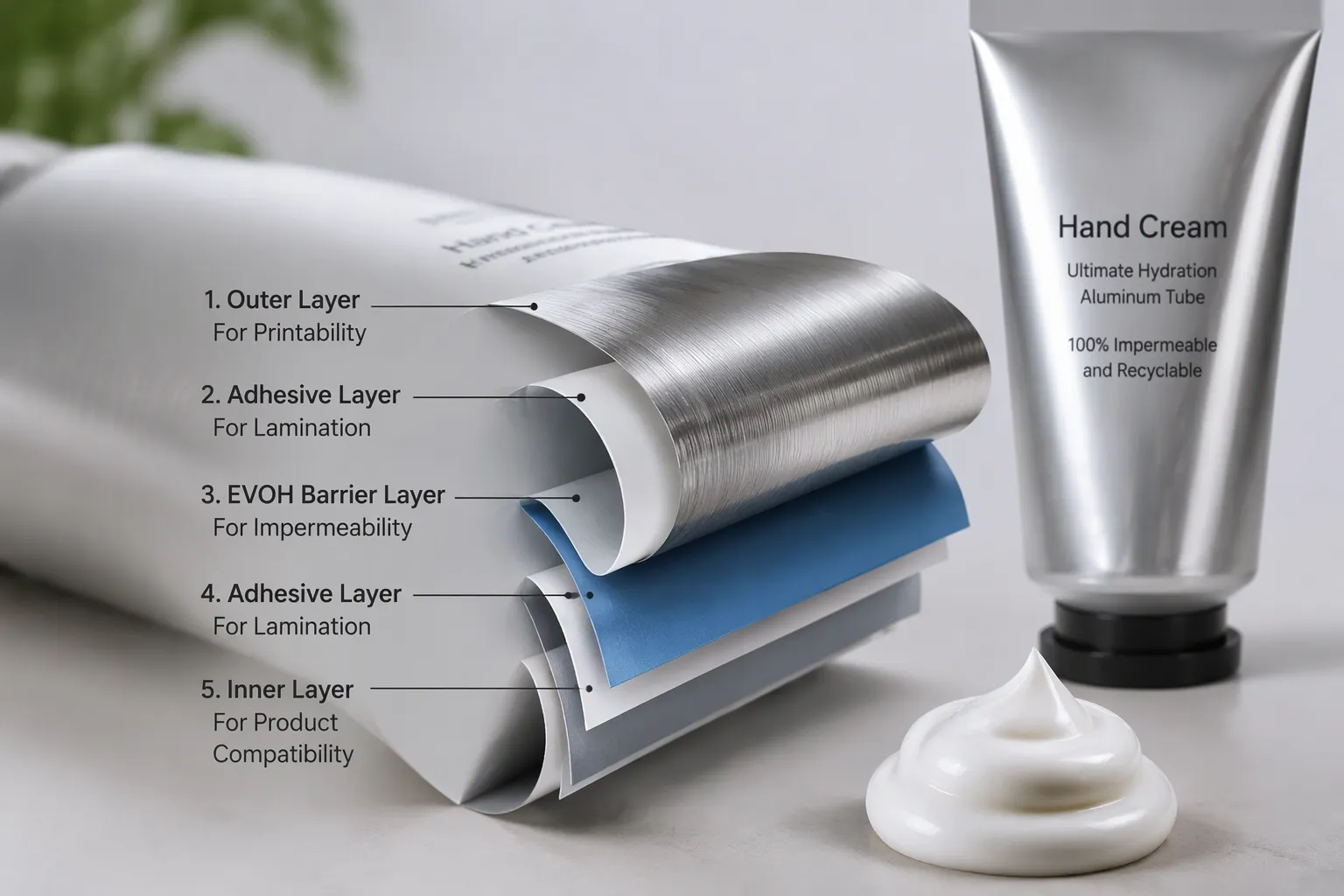
A hand cream formula often carries fragile ingredients. Oxygen, moisture, and light can degrade those ingredients before the customer finishes the tube. Multi-layer construction solves this problem inside the tube wall. Othilapak explains that barrier layers such as EVOH (ethylene vinyl alcohol) dramatically reduce oxygen transmission, prolong shelf life, and preserve ingredient potency. EVOH is sensitive to moisture, so manufacturers encapsulate it between hydrophobic PE layers. Modern cosmetic tubes can feature five or more layers, each with a job: outer printability, mechanical strength, barrier protection, and product compatibility. A five-layer plastic tube places EVOH at its core, where it blocks gases, oils, and solvents while the inner and outer PE layers hold shape and resist outside damage.
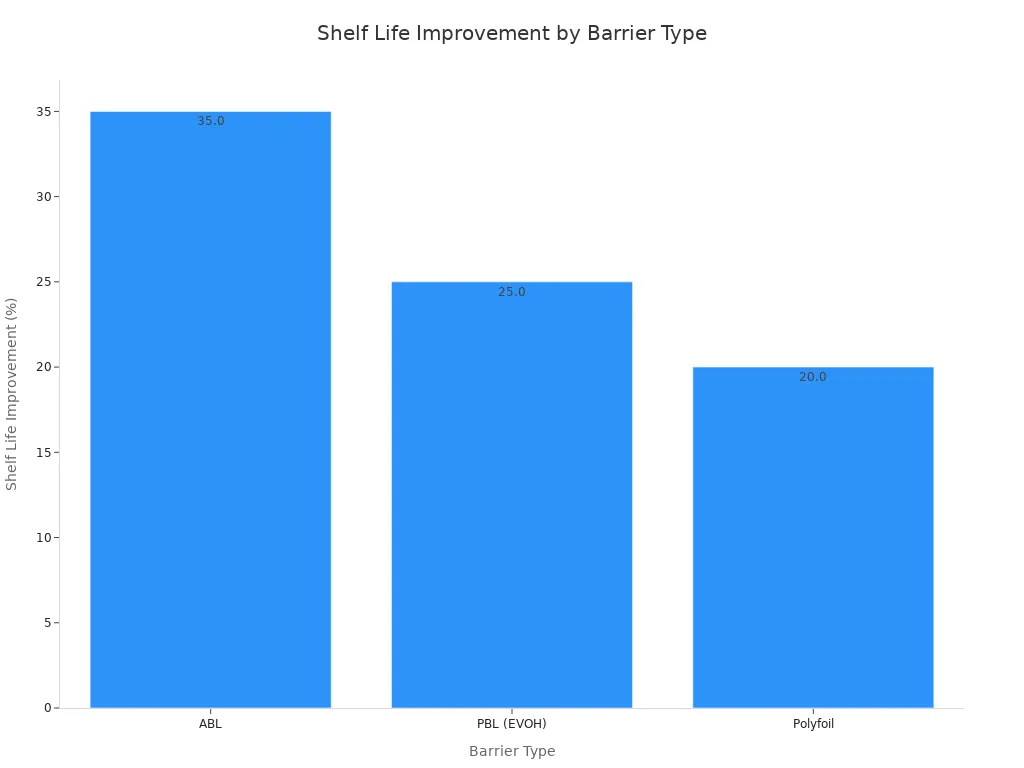
Barrier choice changes shelf-life outcomes. According to yzhyti.com, ABL tubes deliver a 30–40% shelf life increase for sensitive and medicated formulas, PBL tubes with EVOH deliver 20–30% for natural creams, and Polyfoil delivers 15–25% for standard creams. The same source illustrates these gains in a bar chart of shelf life improvement by barrier type:
Aluminum cosmetic tubes take a different route. Lisson Packaging notes that aluminum is impermeable to light, moisture, and air, which suits active-rich skincare and sensitive formulations. Tubenaire adds that internal lacquering makes the tube impermeable to moisture, gas, odor, and light, and minimizes air entry that could dry the product out. Choose aluminum where light and oxygen sensitivity dominate; choose EVOH structures where flexibility and a lighter tube matter. Jars and bottles still fit thick, scoopable textures well. For flowable hand creams, though, tubes deliver stronger product protection per gram of material.
Dispensing design decides how much formula leaves the tube and how much contamination enters. Flip-top lids use a hinged cap with a snap or click closure. Cosmeticplastictube.com notes that this seal keeps the tube tightly closed between uses and prevents accidental spills. The user squeezes the tube body, and the orifice releases a controlled amount. Disc-top caps work on the same principle: press the disc, squeeze, and the product flows. Lisson Packaging describes disc-top caps as one-handed, leak-proof, and excellent for managing lotion flow.
These convenient tubes suit single-hand use in a bathroom or at a desk. Controlled dispensing also supports hygiene, because the formula stays inside a sealed body until you squeeze. Airless and pump formats go further. Othilapak reports that airless and pump tubes, often paired with multi-layer barriers, limit contaminant entry during dispensing and support product hygiene. Match the closure to the formula: a thin lotion flows well through a disc top, a richer cream may prefer a flip top with a wider orifice. Either way, the closure must prevent leakage and contamination across the product's life. That requirement sits at the heart of storage, dispensing and protection requirements for any hand cream tubes you specify.
Compliance for cosmetic packaging rests on three rule sets. Phoenix Cosmetic Safety groups them clearly:
|
Rule set |
What it governs for packaging |
|---|---|
|
The Cosmetics Regulation |
Packaging considered in the safety assessment for compatibility and migration; carries the mandatory label information |
|
Chemicals law |
Substances in the packaging materials |
|
Packaging waste law (UK Extended Producer Responsibility; EU Packaging and Packaging Waste Regulation) |
Reporting, fees, recyclability and marking |
A compliant pack satisfies all three. Your safety assessor must also review the pack itself. Section A4 of the Cosmetic Product Safety Report requires details on the packaging material, including purity and stability. Section A3 covers microbiological quality and asks how the consumer accesses the product. The report is valid only for the product in the packaging assessed. Switch from a tube to a jar, and the assessor must review it again.
Compatibility runs in two directions. The product must not damage the pack, and the pack must not contaminate the formula. Plasticisers, monomers, and colorants can migrate into the cream. Ask your supplier for a declaration of compliance covering REACH, heavy metals, and food contact suitability where relevant. Article 19 also requires the container to carry the Responsible Person address, nominal content, batch number, and ingredient list. Small tubes need a label solution that fits these elements.
Tube formats differ on cost and fit, and each suits a different brand need. Xinflypackaging notes that plastic laminated tubes are lightweight and low cost, with easy printing for branding. Aluminum tubes cost more to make but offer a strong barrier and a premium feel. Airless pump tubes cost more and are harder to make, yet they keep air out and extend shelf life for rich moisturizing creams. Sample or mini tubes cost more per milliliter but suit trial sizes. Match the format to your formula and budget rather than to a ranking.
Lisson supports brands in matching tube specifications to compliance and budget requirements. The company offers plastic cosmetic tubes from 5ml to 300ml, multi-layer PBL and ABL structures, and PCR and mono-material options for recyclability. Factory-direct pricing, ISO-certified facilities, and a minimum order quantity of 10,000 pcs per item help you plan empty squeeze hand cream tubes around both regulatory needs and cost targets.
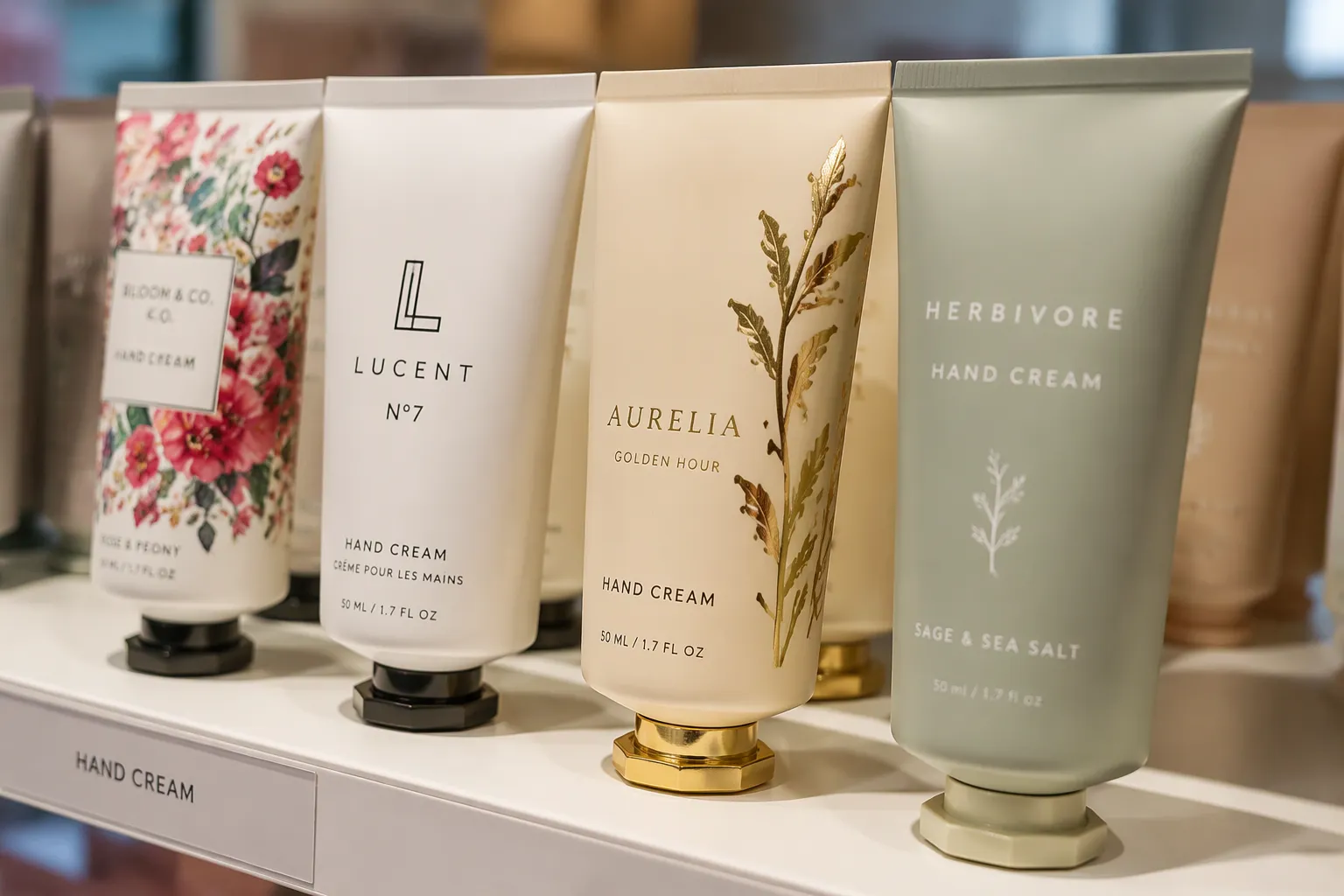
The tube body gives you a broad, uninterrupted print surface. That surface carries eye-catching graphics, vibrant colors, and informative labeling. The Tube Packaging notes that customers make split-second judgments based on shelf presentations, so the visual appearance of a tube influences purchase decisions as much as the formula does. Decoration options differ in effect, and each fits a different brand need:
|
Decoration / Finish |
Shelf-appeal effect for hand creams |
|---|---|
|
Offset Printing |
Colorful designs, fragrance illustrations, product claims and retail details |
|
Silk Screen Printing |
Clean, sharp, high-density logo effects for minimalist or premium lines |
|
Hot Stamping |
Gold, silver or rose-gold foil accents for a gift-ready appearance |
|
Heat Transfer |
Complex artwork, floral graphics, gradients and high-resolution designs |
|
Matte Finish |
A clean, soft, modern skincare appearance |
|
Glossy Finish |
Stronger color expression and shelf impact |
|
Soft-Touch Coating |
A velvet-like hand feel that matches premium positioning |
|
Pantone Color Matching |
Consistent tube body, cap, shoulder and artwork across a collection |
Base color shapes perception before a customer reads a word. White communicates purity and simplicity, black suggests luxury, clear materials show the product, pastels appeal to gentle formulations, and metallics convey advanced science, according to The Tube Packaging. Signature colors used consistently across a line build recognition and help shoppers find your products among shelf clutter.
Cosmetics packaging is often the first point of contact between consumer and product. Packaging Gateway observes that in a market where compositions are similar, packaging can be the distinguishing factor between brands. Your typography, logo, and color palette work together to shape perception, and consistent design across products reinforces brand recall. This is where packaging design and branding meet: the tube becomes a silent salesperson that states benefits, ingredients, and uses.
The experience at point of use matters just as much. Evergreen Resources notes that narrow nozzles and pumps minimize contamination risk, squeeze control reduces waste, and flip-tops enable one-handed use. Lightweight, shatterproof tubes travel easily. Satisfied users become repeat buyers and advocates, Enki Pack reports. One industry voice puts the shift plainly:
Tubes are becoming the new luxury format in skincare. Not just for practicality, but because they signal premium formulations, cleaner dispensing, travel convenience, ingredient protection, and modern sustainability.
Lisson supports this canvas with digital print, hot stamping, silk-screening, and labeling, plus matte, glossy, metallic, and soft-touch finishes. Custom diameters, caps, and Pantone matching keep every empty squeeze hand cream tube on brand.
You weigh product protection and branding together, not one after the other. The tube wall that blocks oxygen also carries your artwork, so the material choice sets both your shelf life and your shelf look. Lisson helps you read that trade-off in one view.
|
Feature |
ABL |
PBL |
|---|---|---|
|
Barrier layer |
Aluminum foil |
Plastic, often EVOH |
|
Protection |
Almost absolute |
Excellent, slightly less |
|
Squeeze behavior |
Dead-fold, stays creased |
Bounce-back, recovers shape |
|
Recyclability |
Not fully recyclable |
Fully recyclable |
|
Best fit |
Sensitive creams needing high barrier |
Cost- and recycling-focused briefs |
Xinfly Packaging describes ABL as the high-barrier option for sensitive skincare, while PBL suits mid-range products where cost and recycling weigh heavily. Famer Packaging adds that PBL recovers more readily after repeated squeezing, which daily-use hand creams benefit from. Aluminum serves brands that put formula protection first. Lisson Packaging explains that a pure aluminum tube carries an internal protective lacquer and collapses as product leaves, so air cannot re-enter. Function Packaging lists aluminum at roughly 30–50% more than plastic, with unit prices from $0.15 to $0.90 against $0.05 to $0.35 for plastic. That premium buys premium positioning as well as barrier strength.
Lisson aligns technical performance, application fit, regulatory compliance, and cost with your branding goals. Decoration turns a plain hand cream packaging tube into a brand asset. The Tube Packaging lists offset printing for photographic color accuracy, screen printing for durable spot colors, hot stamping for metallic accents, and shrink sleeves for full-surface graphics. Io Packaging adds embossing and debossing for a premium tactile feel. Auber Packaging lists soft-touch coating for a velvety, grippy finish that resists fingerprints. Volume matters most: Xinfly Packaging quotes roughly $0.18–$0.25 per piece at 5,000 units and $0.09–$0.14 at 100,000 or more.
Lisson guides you through a practical sequence:
Confirm fill volume, diameter, material, and orifice against the formula.
Match the tail-seal structure to the contract filler's equipment.
Provide editable vector artwork and approve a print proof.
Request physical samples and run a compatibility and filling trial.
Approve a golden sample before mass production begins.
Confirm MOQ per SKU, not just total volume.
Each format fits a different brief. Lisson helps you match empty squeeze hand cream tubes to yours.
Hand cream packaging tubes deliver two wins at once. They shield your formula through reliable product protection, and they give your brand identity a broad, printable surface.
Choose a tube on technical performance, application fit, regulatory compliance, and cost. Trend alone makes a poor guide. Weigh each option against your own formula and market, and let Lisson support that evaluation.
Thoughtful packaging design builds trust over time. Every empty squeeze hand cream tubes you ship carries both your formula and your promise, and consistent choices keep customers coming back.
Aluminum tubes block light, air, and moisture almost completely. Choose them for active-rich formulas. Multi-layer plastic tubes with an EVOH core also cut oxygen transmission and suit most daily creams. Match the barrier to your formula's sensitivity, not to a default habit.
Your safety assessor must review the pack itself, including material purity and stability. Request a declaration of compliance covering REACH and heavy metals. Confirm the label carries the Responsible Person address, nominal content, batch number, and ingredient list. Packaging design choices cannot bypass these steps.
Offset printing delivers photographic color for detailed artwork. Screen printing gives sharp, durable logos for minimalist lines. Hot stamping adds metallic accents for gift-ready products. Soft-touch coating creates a velvety feel that supports premium positioning. Select decoration after you settle the tube format.
Confirm fill volume, diameter, material, and orifice first. Then match the tail-seal structure to your filler's equipment. Approve a print proof and physical samples before mass production. Check minimum order quantity per SKU. This sequence keeps packaging design, compliance, and cost aligned from the start.
Yes. A lightweight, shatterproof tube travels easily and dispenses cleanly with one hand. That experience reinforces trust each time someone uses it. Consistent cosmetic packaging across a line strengthens recognition. Thoughtful product packaging turns routine use into a repeated brand impression, and empty squeeze hand cream tubes carry that promise every day.