무엇을 찾고 계신가요?

Dip tube length must match the bottle's internal height and the pump design. This match ensures proper priming, consistent dispensing, and minimal product waste.
Two failure modes cause most complaints. A dip tube that is too short leaves product unreachable at the bottom. A tube that is too long bends, kinks, or curls, and that blocks flow.
The right tube length sits between these extremes.
This post shows how to measure the tube, cut it, and test it with the real formula. Readers can then confirm the fit on any pump bottle before production begins.
Measure the bottle's inside depth accurately. Subtract 1/8 to 1/4 inch for the dip tube length.
Match the dip tube end cut to your formula. Use a slanted cut for thick lotions and a square cut for thin liquids.
Test the pump with your real formula, not water. This shows how the pump really works with your product.
Re-test the dip tube length whenever the bottle, pump, or formula changes. Each change can affect performance.
A well-fitted dip tube saves product and keeps customers happy. It prevents waste and ensures the pump works to the last drop.
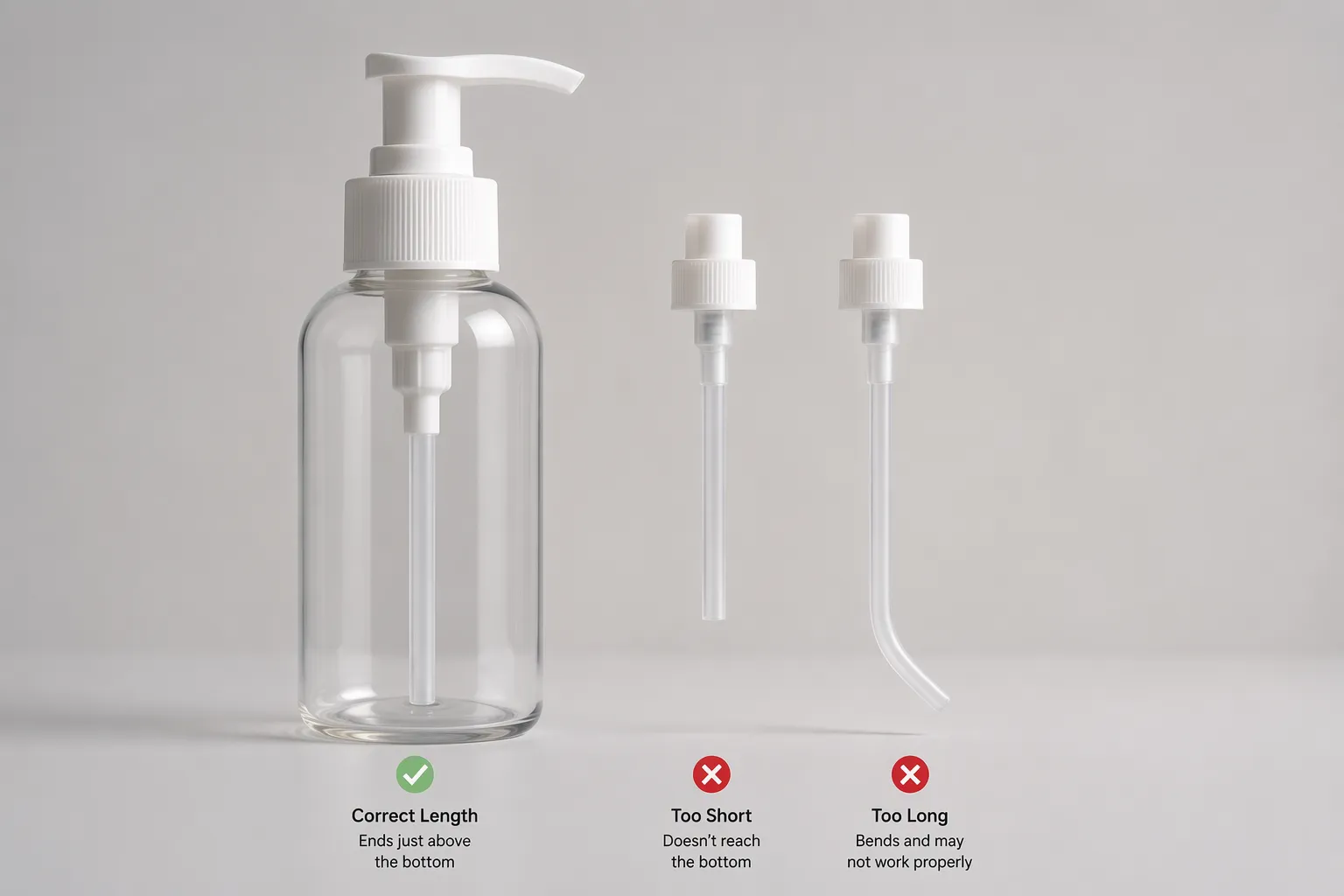
An improper tube length disrupts liquid flow. It prevents the pump or sprayer from working as intended. The pump or sprayer's dip tube length must reach the formula at every fill level. It must also avoid pressing against the bottle base.
A newly filled package may need several strokes before product reaches the actuator. The exact number changes with the pump design, tube length, and formula viscosity. A pump that primes quickly with water may need more strokes with a thicker formula. The goal is not maximum tube length. The goal is reliable product pickup without excessive bending or blockage.
The correct setup depends on internal bottle height, shoulder, base shape, pump engine, cut angle, formula viscosity, and fill level. As the product level changes, the dip-tube pickup condition and headspace can change. A flat-bottom cylinder bottle does not position the tube in the same way as a bottle with a raised or curved base. The shoulder can also change the space available between the pump and the main bottle body.
A dip tube that's too short creates one set of problems. The inlet leaves the formula early. Product near the bottom stays unreachable no matter how many times the user presses the pump. The pump stops dispensing before empty, and the customer sees visible product left at the bottom of the bottle. This is not something a user can fix by trimming. A too-short tube cannot be lengthened. The brand needs a longer dip tube or a taller pump variant sized correctly for the bottle.
A tube that is too long creates a different set of problems. The tube bends, kinks, or curls at the bottom. This restricts flow and interferes with dispensing performance. In narrow bottles, the tube may press against the base or sidewall. The pump may draw air instead of liquid. Output becomes uneven or stops entirely. A tube that is too long may also prevent the pump from screwing down fully.
Both cases hurt pump, sprayer, and mister performance. They reduce pump performance and dispensing efficiency and increase product waste. An incorrectly cut tube can leave 10-15% of a lotion bottle's fill volume unreachable. Even a small gap matters at scale. A 500ml bottle with 8mm of unreachable product loses 1.6% of product at the bottle end. Across 10,000 units, that equals 8 liters of wasted formula.
These failures also damage customer satisfaction. A pump bottle that quits early feels defective. Users blame the pump, not the tube. The fix starts with correct measurement. A dip tube should sit about 1/8" to 1/4" (3-6 mm) shorter than the inside depth. For example, a bottle with an inside depth of 6 3/4" works well with a 6.5" dip tube. Bottles with a curved or domed base need a touch more clearance than flat-bottomed bottles.
The correct cosmetic pump dip tube length depends on internal bottle height, base shape, and pump engine. Brands should test dispensing at different fill levels. Checking only a full bottle misses the end-of-life behavior that frustrates users most. This is especially important for cosmetic airless pump bottles and empty cosmetic pump bottles, where the internal geometry often differs from standard lotion bottles.
The starting point for matching a pump or sprayer's dip tube length to your bottle is the inside depth, not the outer height. Wall thickness does not reflect the true internal depth, so an outside measurement alone will mislead.
A simple sequence gives a reliable figure:
Stand the empty bottle on a flat surface.
Lower a straw, dowel, or an old tube into the bottle until it touches the inside of the base.
Mark the point level with the top of the neck, then remove the object.
Measure from the mark to the end. That distance is the inside depth.
A technical drawing or spec sheet works just as well when one is available. Without a drawing, the straw method remains the most practical route. The measurement runs from the inside bottom to the sealing surface where the pump collar sits. Next, subtract the pump gasket thickness and allow for the bottle bottom shape. A domed or curved base needs extra clearance, while a flat base needs less.
Supplier references usually define dip tube measurement from a gasket or sealing datum to the tube tip, not from the visible plastic alone. Procurement drawings should state both the length and the measurement method, backed by an approved physical sample. This removes ambiguity when a spec sheet lists a figure without showing where it begins.
Measure the existing dip tube length against that same datum, then compare it to the calculated target. A tube that sits about 1/8" to 1/4" (3–6 mm) shorter than the inside depth is the working target. Most dip tubes are custom made to fit a specific pump or sprayer, so the tube and the engine arrive as a matched set. Tube diameter often correlates to pump output, which means a swap in tube size can change dose behavior. Lisson can supply sample tubes and review specs before a full order, which lets buyers confirm the fit on the actual cosmetic pump.
Thick creams and lotions move slowly through a narrow opening. They need more clearance at the base and a wider inlet than thin toners or sprays. A heavy formula also resists flow along the tube wall, so a longer path adds resistance. The relationship between formula viscosity and pump performance is direct: the thicker the product, the more the dip tube length and inlet style must support steady pickup.
Thin formulas behave differently. They flow easily and reach the inlet from most angles, so a shorter tube with a smaller bore often works well. Thin products also expose the inlet to air sooner when the bottle tilts. The dip tube that's too short will draw air while product still sits in the base. Matching tube length to the fill level and the expected tilt keeps the inlet submerged longer.
The end cut controls how the inlet meets the base. A slanted cut at the end of the tube is ideal for thicker products, like lotions, as it facilitates smoother dispensing. Many suppliers recommend cutting the dip tube at a 45-degree angle, which allows for seamless dispensing.
|
Configuration |
Design intent |
Main risk |
|---|---|---|
|
Square cut |
Simple manufacturing with a controlled gap |
A flat end can seal against a flat base if too long |
|
Angled cut |
Keeps part of the inlet open near the base |
Spec ambiguity: measure to the longest tip and define the angle |
|
V-notch or castellated inlet |
Provides alternate flow paths near the bottom |
Tooling and particulate trapping need assessment |
|
Curved-to-corner tube |
Places the inlet near a low perimeter point |
Excess length can kink or preload the pump |
Bottle geometry changes the ideal length and cut. A curved or narrow base collects liquid in one spot, so the tube must reach that point without pressing the wall. Thinner dip tubes found mostly on sprayers should bend toward the container wall to maximize product dispensing. Buyers should confirm the tube path on the actual bottle, including cosmetic airless pump bottles and empty cosmetic pump bottles with raised or sloped bases.
Testing starts with the actual formula, not water. Water can screen fill volume or gross leakage, but it cannot show chemical compatibility with the final cosmetic. The real formula may differ in viscosity, surface tension, solvent power, volatility, fragrance content, pH, and particle load. Each of these factors changes how the pump behaves.
A structured test sequence catches problems early:
Start with an unused pump and record how many strokes it takes to dispense product consistently.
Measure the output amount across several strokes and check that output stays stable.
Confirm the bottle, pump, and dip tube under test match the versions planned for production.
Store filled bottles upright and horizontal to check for leakage at the closure, gasket, actuator, and tube connection.
Repeat the lock function test to confirm the actuator stays secure.
ASTM's pump-priming practice (D3890-18R25) determines the number of actuations needed to prime a dispenser with a consumer product. Its pump-output practice (D4336-18R25) measures the average quantity by weight delivered per actuation. These are different measurements, and brands should record them separately. The evacuation percentage equals dispensed product mass divided by initial net fill mass, multiplied by 100.
Several errors undermine a test run. Measuring from the top of the cap adds the closure height to the number, so the tube ends up too short. Using the outside height includes the base, so a tube cut to that length hits the bottom and bends. Cutting straight across right to the bottom lets a flat-cut tube seal against the base and starve the pump. Skipping the assembled-unit test hides problems that only appear when the full package pumps.
The pump and bottle combination deserves review as one system. ASTM's pump-component compatibility practice (D4333/D4333M-18R25) addresses how mechanical dispenser components interact with products. ISTA's official retesting guidance calls for repeating tests whenever the product, package, or process changes. Lisson supports assembled pump and bottle testing to catch these issues before production, including checks on cosmetic airless pump bottles and empty cosmetic pump bottles.
Four checks protect performance. Measure the bottle's internal height, subtract for the gasket, match the tube end to viscosity and base shape, and test the assembled unit with the real formula. Each step takes minutes and prevents costly rework.
Correct tube length protects product yield and pump reliability at the same time. A well-fitted dip tube reaches the last milliliter without bending, and the pump keeps its dose steady to the end. Pre-production testing remains the cheapest quality check available.
Buyers should confirm tube length as part of the bottle–pump–formula trio. Lisson can support sample testing and spec review before an order. A verified dip tube and cosmetic pump pairing removes guesswork from the first production run.
A tube should sit about 1/8" to 1/4" (3–6 mm) shorter than the inside depth. This small gap prevents the tube from pressing against the base. Bottles with a curved or domed bottom need a little more clearance than flat-bottomed bottles.
No. A short tube cannot be lengthened, and trimming only makes the problem worse. The brand must supply a longer dip tube or a taller pump variant. Users cannot correct this issue at home.
Yes. A slanted cut keeps part of the inlet open near the base, which suits thicker lotions. A square cut works with a controlled gap. The cut must match the formula and the bottle bottom shape.
Water cannot show chemical compatibility with the final cosmetic. The real formula differs in viscosity, surface tension, and solvent power. Each factor changes how the pump primes and doses. Testing with water hides problems that appear only with the actual product.
A brand should re-test whenever the bottle, pump, or formula changes. A new bottle shape shifts the internal height. A thicker formula changes flow. A different pump engine changes the tube fit. Each change deserves a fresh assembled-unit check.